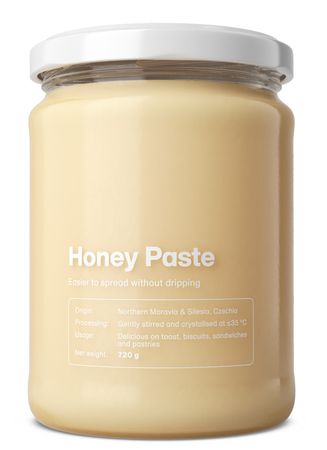
Vilgain Creamed Blossom Honey – Natural Crystallization Under Control 🍯
Honey naturally crystallizes over time. While some types remain liquid for a long time, others begin to solidify within just a few weeks. This depends mainly on their composition. For our blossom honey, we control this process by regular mechanical stirring at temperatures up to 35 °C. The result is a smooth, creamy texture that is easy to scoop and spread.
How is honey made? 🐝
Bees collect nectar from flowering plants and carry it to the hive, where they gradually process it using their own enzymes and reduce its water content.
During this process, some of the sucrose is broken down into simpler sugars, mainly glucose and fructose. These make up the main portion of sugars in honey and also influence its final properties. Once matured, bees store the honey in honeycombs, which they seal with wax. The beekeeper then extracts it and prepares it for further processing.
Why does honey naturally crystallize?
The speed of crystallization depends mainly on the ratio of two naturally occurring sugars:
- Glucose is less soluble in water and therefore more easily forms crystals.
- Fructose is more soluble and helps honey stay liquid for longer.
The water content and storage temperature also play a significant role. Honey with a higher proportion of glucose therefore usually crystallizes faster than honey with more fructose.
Crystallization is not a sign of spoiled or low-quality honey. It is a natural physical process in which some of the glucose turns into a solid crystalline form.
How does creaming work?
With normal crystallization, honey can develop crystals of various sizes, which affect its texture. During creaming, the honey is regularly stirred, which encourages the formation of small, evenly distributed crystals.
Creamed honey thus acquires a smooth texture without noticeably coarse crystals. Compared to liquid honey, it drips less and sticks better to bread.
Creaming does not change the basic composition of honey. It does not require the addition of sugar, milk, or any other ingredients. The difference compared to liquid honey lies mainly in its physical structure.
Blossom honey from Northern Moravia and Silesia 🇨🇿
Our honey comes from Northern Moravia and Silesia, where bees collect nectar from various types of flowering plants. The local vegetation typically includes dandelions, white clover, maples, raspberries, bird cherries, and fruit trees.
Nectar availability depends on the season, weather, and blooming period of individual plants. Therefore, individual batches of blossom honey may naturally differ in color, taste, aroma, and crystallization speed.
Creamed vs. liquid honey – what’s the difference?
Both creamed and liquid honey can come from the same raw material. The difference lies mainly in the method of crystallization and the resulting texture.
| Property | Liquid honey | Creamed honey |
| Texture | Liquid | Smooth, creamy |
| Crystallization | Occurs naturally during storage | Controlled during processing |
| Structure | May develop crystals of various sizes over time | Small, evenly distributed crystals |
| Processing | Without creaming | Regular mechanical stirring |
Both variants contain naturally occurring sugars and other honey components. Creaming itself does not increase nutritional value, but it affects the texture and method of use.
How to store creamed honey?
Keep honey in a well-sealed jar, in a dry place and away from direct sunlight, ideally at temperatures up to 20 °C.
Higher temperatures may affect its crystalline structure and texture. To maintain its smooth texture, there is no need to heat the honey before use.
It is suitable on bread, in yogurts, porridges, or for sweetening dishes and drinks.
Vilgain Creamed Blossom Honey at a glance:
- 100% blossom honey
- Origin: Northern Moravia and Silesia, Czech Republic
- Mechanically creamed at temperatures up to 35 °C
- No added ingredients
- Smooth, easily spreadable texture